News | October 9, 2025

Circular Economy Month: Strengthening the Domestic Supply Chain Through Lead Battery Recycling

Graphic showing the circular economy of lead batteries where battery recycling fuels the domestic supply chain for new batteries.

October is Circular Economy Month, a time to spotlight how industries are transforming waste into resources, conserving materials, and operating a closed-loop economy. The lead battery industry is a prime example of these principles in action, with batteries designed for recycling, a nationwide collection infrastructure, and zero-waste recycling practices. By reclaiming valuable materials for new batteries, the industry supports domestic supply chains for critical materials and powers vehicles, essential backup systems, and battery energy storage systems.

At the Association of Battery Recyclers (ABR), we celebrate Circular Economy Month by highlighting the economic and strategic impact of lead battery recycling—a proven model for material recovery and domestic manufacturing strength.

What Is a Circular Economy?

A circular economy is an economic model that focuses on minimizing waste, maximizing resource efficiency, and keeping materials in use for as long as possible. Unlike a traditional linear economy—take, make, dispose—a circular economy emphasizes recycling, reuse, and renewal, reducing waste while supporting long-term resource stability and growth.

Lead batteries are a real-world example of this model: nearly every component of a lead battery can be reclaimed and reused, creating a closed-loop system that ensures resource availability and reinforces domestic energy and manufacturing security.

The Lifecycle of a Lead Battery

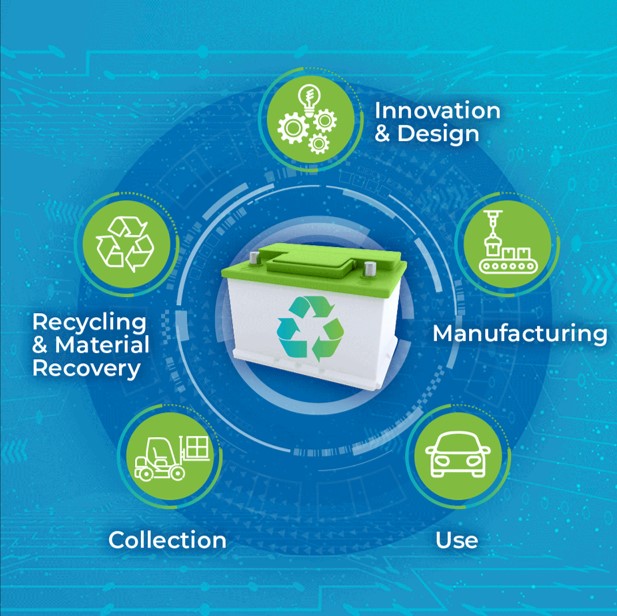
Animated GIF with the stages of the lead battery circular economy.

The lead battery recycling process exemplifies the circular economy through a comprehensive, closed-loop lifecycle:

  1. Innovation and Design: Lead batteries are designed from the start for recyclability. Manufacturers engineer components for easy disassembly and material recovery.
  2. Manufacturing: New lead batteries are built for performance, durability, and recyclability. They typically contain up to 80% recycled materials, reducing the need for virgin lead, tin, antimony, and plastics.
  3. Use: Lead batteries provide reliable power for vehicles, industrial equipment, forklifts, telecommunications networks, data centers, and other critical infrastructure.
  4. Collection: When batteries reach the end of their life, they are returned through a nationwide infrastructure of more than 300,000 collection sites, ensuring safe handling and transport.
  5. Recycling & Material Recovery: The recycling process recovers nearly 100% of the lead, as well as plastics, sulfuric acid, tin, and antimony—all of which are repurposed into new batteries or industrial materials.
  6. Renewal: Reclaimed materials feed directly back into manufacturing, completing the loop and maintaining a steady domestic supply of critical resources.

This lifecycle keeps valuable materials in circulation, reduces dependence on imports, and strengthens domestic energy resilience.

Circular Economy Spotlight: The Sustainable Life of Lead Batteries

To illustrate the impact of lead battery recycling, ABR produced the video “Circular Economy Spotlight: The Sustainable Life of Lead Batteries.” This engaging video takes viewers on a journey through the full lifecycle of a lead battery, showcasing how design, recycling, renewal, and reuse work together to create an infinite loop that minimizes waste and keeps critical materials available to domestic manufacturers.

The video has been recognized with a Platinum Viddy Award for excellence in production and education and has reached more than 60,000 viewers across YouTube and social media. It continues to serve as a valuable resource for ABR members and stakeholders to demonstrate the circularity and reliability of lead battery recycling.

Watch the video below to discover how the lead battery industry leads the way in closed-loop practices and strengthens America’s material supply chain.

Economic Benefits and Energy Security

The lead battery circular economy plays a vital role in maintaining U.S. energy security and economic stability:

  • Job Creation: The U.S. lead battery industry supports over 106,000 jobs in manufacturing, collection, transport, and recycling operations.
  • Domestic Supply Chains: Approximately 70% of U.S. lead demand is met by domestic recyclers, reducing reliance on imported materials and keeping critical resources within reach.
  • Energy Storage Support: Lead batteries provide dependable backup power for data centers, telecommunications networks, hospitals, and industrial systems that support daily life and national operations.
Essential applications supported by lead batteries.

Environmental Benefits of Lead Battery Recycling

Lead battery recycling continues to be one of the most efficient material recovery systems in operation today:

  • Waste Avoidance: Recycling keeps materials from becoming waste, protecting soil and water quality.
  • Resource Conservation: Reclaimed lead, tin, antimony, plastic, and acid reduce the need for virgin materials, supporting a sustainable supply of critical raw materials.
  • Circular Design: Nearly all recycled materials re-enter the manufacturing process, ensuring a reliable domestic source of key resources.

Lead Battery Recycling and the Future of Energy Storage

As the demand for batteries continues to grow across sectors, lead batteries remain essential to the nation’s energy infrastructure. Their proven circular lifecycle provides a secure and scalable model for meeting the needs of an increasingly electrified economy.

Lead battery recycling supports energy security, strengthens domestic supply chains, and ensures that critical materials remain available to meet the expanding demand for backup power, mobility, and industrial energy storage.

Closing the Loop for a Secure Energy Future

The success of the lead battery circular economy proves that secure and resilient manufacturing is achievable today. By recovering and reusing materials at scale, ABR member companies keep valuable resources in circulation, reduce dependence on imports, and build a stronger domestic economy.

Recent federal discussions around designating lead as a critical mineral highlight just how vital recycling is to America’s supply chain. With no primary lead production in the United States, recycled lead from used batteries provides the nation’s only domestic source of this essential material. This closed-loop system not only conserves resources but also strengthens national security, supports domestic manufacturing, and ensures a stable supply of materials for vehicles, renewable energy storage, and backup power systems.

As industries and policymakers look for proven models of circularity, lead battery recycling stands out as one of the most efficient and effective systems in operation. The Association of Battery Recyclers will continue to promote innovation, education, and responsible recycling practices that strengthen America’s energy and manufacturing future.

Share:
Skip to content