

Lead battery recyclers are essential to a proven circular economy, responsibly recycling more than 174 million lead batteries in the U.S. each year and recovering critical minerals and other valuable materials for reuse. This important work would not be possible without the dedication of our employees.
North American lead battery recyclers are committed to prioritizing the health, safety and well-being of our employees, their families and the communities in which we live and work. We comply with rigorous environmental, health and safety (EHS) standards and continually work to strengthen our industry practices.
Watch this short video to learn more about the measures the lead battery industry takes to ensure employee safety and wellbeing.

Our members make substantial, ongoing investments to ensure their operations meet and exceed the highest environmental, health and safety regulatory standards in the industry.
From clean and dirty locker rooms, decontamination protocols, air filtration systems, personal protective equipment, and ongoing health monitoring, protecting employees is our highest priority.
View our employee health and safety infographic to find out more about how lead battery recyclers ensure the health and safety of our employees.

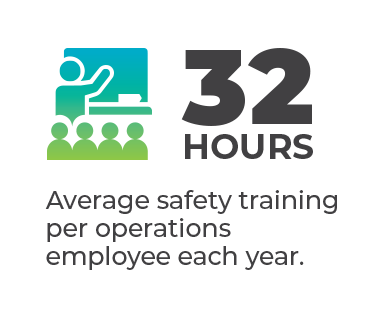
Safety is a shared responsibility between the company and its employees. Rigorous, ongoing safety training programs give employees the knowledge, skills and awareness necessary to ensure their own safety in the workplace, as well as the safety of others.
To protect workers from hazardous substances and injuries, we use sophisticated safety equipment, including advanced workplace and environmental exposure controls.
Lead battery recyclers provide workers with the necessary personal protective equipment (PPE) to safeguard them for the work they do. Between 2012-2022, U.S. lead battery recyclers invested an average of $7 million in PPE per facility.
Recyclers take personal hygiene very seriously, which is why showering to remove any workplace contaminants is required before leaving the facility. To further maximize protection, everything from safety masks to undergarments and clothing are laundered and sanitized onsite by the recyclers — nothing is taken home.
To protect our employees, their families and the community from hazardous substances, lead recycling facilities make use of sophisticated safety equipment and practices, including body vacuums, handwashing stations and lead-check stations that help detect and prevent lead dust from leaving the facility.

Our member companies understand that cleaning the air is crucial to a healthy workplace. Lead battery recycling facilities rely on the extensive use of industrial ventilation and air filtration solutions to draw dust and fumes away from workers and to help protect the environment.

Plant workers participate in regular health monitoring, including initial employment physicals, blood-lead level monitoring and ongoing testing to ensure our efforts continue to be effective.
Regularly monitoring the amount of lead in an employee’s blood is the standard for measuring and minimizing lead exposure. As shown in the graphic, our BLL management policies are significantly more rigorous than required by law and highly effective.


North American lead battery recyclers regularly collaborate and share best practices to collectively advance our industry. Keeping our employees, their families and our communities safe and healthy continues to be our foremost priority. From the moment employees walk through the doors to when they return to their families and community, we emphasize the importance of safety.
As an industry, our commitment to safe, responsible lead battery recycling supports the people who make this essential work possible. Through continuous improvement, collaboration and investment in advanced safety practices, ABR members work to protect employees while responsibly recovering the critical minerals and other materials that support U.S. manufacturing and essential infrastructure.


