WELCOME TO OUR BLOG

Industry Collaborations Lead to Shared Solutions to Improve Circularity

November 15, 2023

Graphic depicting industry collaboration to improve sustainability for America Recycles Day.

As the most recycled consumer product in the U.S., lead batteries are a sustainability success story. On this America Recycles Day we’re proud to share that the lead battery industry is perhaps the most successful example of a closed-loop, circular economy.

We also recognize that getting to this point wasn’t easy. It took time, dedication and the action of both government and industry partners to increase the lead battery recycling rate from 60-80% early on to an astounding 99% today.

It’s conceivable that our industry could be the first to achieve 100% circularity. As we continue to seek new ways to take sustainability to the next level, open innovation will be key to our success.

Building an Innovation Ecosystem

ABR member company, Gopher Resource is leading the charge with a collaborative approach to innovation that leverages partnerships beyond our industry to develop shared solutions to common challenges.

Like many companies in our industry, Gopher Resource is creating an innovation ecosystem aimed at solving environmental, social and governance (ESG) and productivity-related problems. At October’s ABR meeting, Dan Graf, Principal Engineer, presented on how Gopher Resource is creating an innovation ecosystem aimed at solving environmental, social and governance (ESG) and productivity-related problems. To date, these partnerships include more than 20 companies, 10 universities/research institutes and three government agencies.

Despite investing heavily in in their own research and development, Gopher Resource understands they may not have the resources or expertise to solve every problem. They are also aware that many challenges are not unique to their operation.

In the spirit of collaboration, the company recently presented some of the solutions they are working on at our fall meeting.

Lead battery recycling industry working together to ensure safety and efficiency

Finding Solutions Together

Gopher Resource is committed to protecting the environment and contributing to a circular economy by creating innovative solutions that further the battery recycling industry’s goals of waste minimization, water reuse and greenhouse gas (GHG) emission mitigation.

To that end, the company has joined several consortiums working to advance sustainability. The Center for Resource Recovery and Recycling (CR3) is focused on the sustainable stewardship of resources. The Materials Recovery Technologies for Defense Supply Resiliency (MRT-DSR) run through Army Research Labs (ARL) is focused on developing all facets of domestic critical metals production capabilities.

Multiple projects are already underway through these partnerships that aim to reduce Gopher Resource’s carbon neutrality and environmental footprint.

The first uses advanced heat transfer technology from the solar energy industry to recover waste heat during the recycling process, making it more energy efficient. This is an industry first for the novel technique and Gopher Resource is working with partners to commercialize this technology.

For the second project, Gopher Resource is working with the University of Minnesota Natural Resource Research Institute in Duluth, and a group of local partners to study the use of charcoal from biomass as an alternative to fossil fuels. The goal of this project is to create a sustainable supply chain that would reduce Gopher Resource’s Scope 1 CO2 net impact by up to 30%, and eventually scale to allow other recyclers to reduce their GHG impact.

Advancing Material Recovery and Waste Valorization

Gopher Resource is particularly focused on becoming a zero-waste operation — working to get as much out of recycling byproducts as possible, then finding new ways to get value out of those materials.

One significant step in this direction is Gopher Resource’s patent-pending SCRUM process, or Slag Cleaning and Recovery of Useful Metals process. The SCRUM process uses furnace fuming technology to separate the tin and lead into a concentrated fume form with very high selectivity and efficiency, leaving behind a “cleaned” bulk iron sodium-silicate “SCRUM Slag.”

The SCRUM process was developed using the company’s philosophy of using existing technology that is commercially available in a different way, rather than creating entirely new technology. This approach mitigates risk and helps bring solutions to market faster.

The innovative process separates 99% of useful metals from lead blast furnace slags, producing LME-grade tin and lead bullion that can be refined and used in new batteries. The remaining SCRUM Slag is an environmentally friendly byproduct that can be repurposed and shows promising potential for commercialization.

The ability to recover these metals from lead battery recycling slag in a safe, economically feasible way is an industry first. Learn more about Gopher Resource’s SCRUM process here.

Sharing Insights to Advance Sustainability

By providing a platform for companies like Gopher Resource to share best practices and innovations with peers, ABR hopes to foster collaboration to solve some of our industry’s toughest challenges. Together, we can make lead battery recycling the most circular industry in the world.

Posted in: News

Tags:

Terrapure Environmental Adds Plastic Recycling Capabilities

November 2, 2023

Congratulations to ABR member company, Terrapure Environmental, on the grand opening of a new state-of-the-art plastic recycling facility at its battery recycling plant in Quebec. With the capacity to recover over 11,000 tons of recycled polypropylene pellets annually, it is the largest facility of its kind in Canada.

The recycling process turns a product that could be hazardous waste into high-quality polypropylene pellets for reuse in manufacturing of new batteries and other products.

The addition of plastic recycling capabilities on site helps close the loop on the battery recycling process for Terrapure and further advances environmental sustainability through the extraordinary circular economy of lead batteries.

Read the full press release to learn more:

Terrapure launches new plastics recycling facility in Ville de Sainte-Catherine

Ville de Sainte-Catherine, Quebec, Canada, October 23Terrapure Environmental today celebrated the grand opening of an innovative new plastics recycling facility at its Ville de Sainte-Catherine battery recycling plant.

This state-of-the-art facility – the largest of its kind in Canada – allows the company to further its contribution to the circularity of the economy in Quebec and Canada by recycling plastic battery casings for reuse in the creation of new products.

Terrpaure operator inspecting recycled plastic pellets
A Terrapure operator inspects recycled polypropylene pellets as they come through the final stage of recycling.

“The opening of this facility is a significant milestone for our company, one that demonstrates not only our commitment to protecting the environment, but also to growing our operations in Quebec,” said Ryan Reid, President and CEO of Terrapure. “By adding plastic recycling to our well-established lead battery recycling capabilities, we are able to further close the recycling loop for our battery manufacturing customers.”

The recycling process, which includes washing and shredding the polypropylene chips from used battery casings, followed by extrusion of the chips to create plastic pellets approximately 3 mm in diameter, is completed entirely at Terrapure’s Ville de Sainte-Catherine location. Terrapure invested close to $30 million to develop the new facility, which currently operates 5 days-per-week, 16 hours-per-day and employs around 15 full-time employees.

Recycled polypropylene pellets.

The pellets are shipped to customers throughout North America by truck or rail to produce new products, including new battery casings. Terrapure can produce approximately 10,000 tonnes of recycled polypropylene pellets annually. Given that lead batteries typically contain 4 to 5 percent plastic by weight, this additional recycling opportunity further strengthens the already impressive success story of the circular economy for batteries.

Terrapure provides a vital service that not only recovers value from what would otherwise be a hazardous waste that would be disposed of, but also helps conserve natural resources and protect the environment. Lead batteries, which are essential to the green energy transition, are the most recycled consumer and industrial product in North America – about 99 percent of batteries are recovered and recycled, far more than any other product – and the components can be reused infinitely.

Additionally, recycling plastic battery casings for reuse generates between 57 and 66 percent fewer greenhouse gas (GHG) emissions at Terrapure’s facilities than the process to produce plastic from conventional manufacturing, according to recent GHG assessments.

“We’re proud to add plastic recycling to our operations in Ville de Ste-Catherine,” said Martin Fournier, Terrapure’s Operations Manager, Plastics Recycling. “This state-of-the-art recycling process allows us to add even more value for our customers and further establishes Terrapure as a circular-economy leader.”

Terrapure recovers over 90 percent of the constituent components in batteries. Each year at its Ville de Ste-Catherine facility and another facility in Mississauga, Ont., the company recycles 12 million spent batteries and has the ability to recover up to 134,000 tonnes of lead and 15,000 tonnes of polypropylene pellets to be reused in the manufacturing of new batteries. The company employees 340+ highly skilled employees between its two plants, including 220+ in Quebec.

ABOUT TERRAPURE

Terrapure Environmental is a leading provider of recycling solutions that contribute to the circular economy of batteries and create value for customers throughout North America. With an unwavering focus on environmental, health and safety excellence, recycle lead batteries and provide recovered lead and plastics to the battery manufacturing industry for reuse in the creation of new products, while significantly reducing waste requiring disposal. At Terrapure, we’re Changing Waste for Good.

For more information, visit terrapureenv.com.

Posted in: News

Tags:

U.S. Lead Battery Recyclers Zero in On Safety

August 8, 2023

Lead battery recyclers zero in on employee safety

Once again, Association of Battery Recyclers (ABR) members are participating in OSHA’s annual Safe + Sound Week, August 7-13. The nationwide event recognizes the successes of workplace health and safety programs and offers information and ideas on how to keep America’s workers safe.

Lead battery recycling employee smiling

This year, ABR is highlighting the ongoing efforts of our members to zero in on safety. As an industry, we are proud of the work being done to protect the health and safety of workers as we continue to strive toward the goal of zero incidents.

Safety Training Empowers Employees to Work Safely

To accomplish this goal, our members engage workers in rigorous, ongoing safety training that gives them the knowledge, skills and awareness needed ensure their own safety, as well as the safety of others. On average, lead recycling industry employees who work on the production floor participate in 32 hours of safety training per year.

Training methods range from classroom instruction and seminars to on-the-job training such as shadowing and hands-on experiences. Depending on their responsibilities, some employees may also undergo additional hours of equipment-specific training.

Lead battery recyclers conduct ongoing health and safety training for employees

As a regular practice, management may use time at the start of shifts to increase awareness of new safety procedures or refresh knowledge of existing safety measures, as well as to discuss any safety concerns the employees may have. Workers also participate in regular training on facility-wide safety and hygiene topics as well as first-aid and CPR classes.

Providing Head-to-Toe Protection Safeguards Against Potential Hazards

It’s no surprise that many lead battery recyclers work in demanding environments to keep the circularity of sustainable lead batteries in motion. Providing the proper personal protective equipment (PPE) is another way the lead battery recycling industry safeguards employees for this important work.

Between 2012 and 2022, ABR member companies invested an average of $7 million in PPE per facility. From hard hats, safety glasses, ear plugs and respirators to gloves, aprons and boots, head-to-toe protection combined with training on its proper usage helps minimize safety incidents.

Lead battery recyclers provide personal protective equipment for employees from head to toe

Check out this infographic to learn more about the types of PPE commonly used by lead battery recyclers, as well as all the ways our members work to ensure the health and safety of their employees.

For jobs that require prolonged exposure to heat, ABR members are working together to lessen the impact of heat on employees by continually updating heat-related safety practices and adding new PPE, such as cooling vests, cooling towels and ice jackets.

Proudly Going Above and Beyond Industry Standards

When it comes to employee health and hygiene, we’re proud to share that U.S.  battery recyclers’ voluntary measures often exceed OSHA standards for our industry and provide better protection for workers and their families.

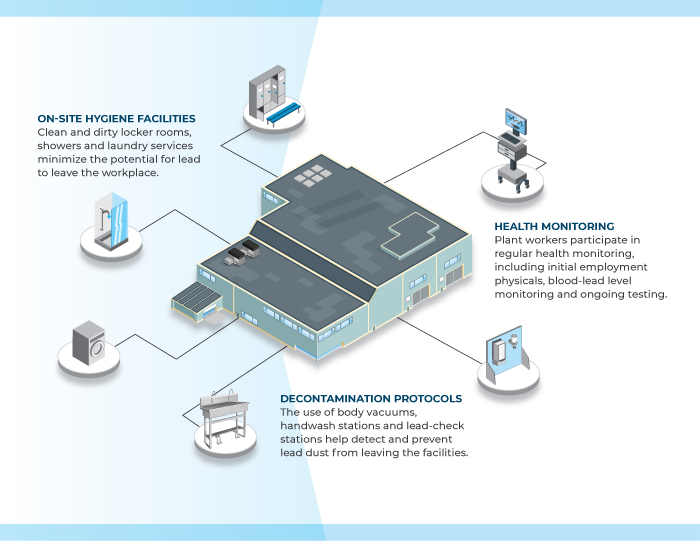
On-site hygiene facilities such as clean and dirty locker rooms, showers, and laundry services for uniforms required as part of PPE, minimize the potential for lead to leave the workplace on employees’ skin or clothing. Additional detection and prevention methods include mandatory decontamination protocols, including the use of body vacuums, handwash stations and lead-check stations.

Lead battery recycling facility illustration for employee health and safety

Regular health monitoring is another way lead battery recyclers partner with employees to ensure they are safe and fit for work.  This can include everything from initial employment physicals to regular testing that maintain thresholds well below OSHA standards.

When safety incidents arise or medical attention is required, many companies have fostered working relationships with local occupational health clinics. Some even employ on-site nurses or medical technicians, which provides an even greater continuity of care for employees.

To proactively prevent illness and injury, ABR member companies invest significant capital to ensure their operations meet, or even exceed, the highest environmental, health and safety regulatory standards in our industry. In the decade spanning 2012-2022, on average per company, lead battery recyclers:

  • allocated 30% of annual operating budget for EHS.
  • dedicated 14% of on-site staff to focus on EHS.

Safety is Our Highest Priority

We all rely on lead batteries to move people and goods, keep us connected, and power essential infrastructure and industry when its most critical. Nearly 100% recyclable, lead batteries are a vital part of our everyday lives, making the lead battery recycling industry integral to a safer, more sustainable future for us all.

Safely recycling lead batteries into quality materials that can be used for new batteries or other products is important work that makes a positive impact on sustainability and the economy. Which is why, today and every day, ABR and its members are committed to prioritizing the health, safety and well-being of our employees, their families and the communities in which we live and work.

Posted in: News

Tags:

North American Battery Recyclers: Working Together to Lessen the Impact of Heat on Employees

June 23, 2023

Worker drinking water for employee heat safety.

Association for Battery Recyclers’ (ABR) Spring Meeting brought together attendees from across the continent to share ideas and best practices and hear from experts and leaders in the industry about the latest developments in technology and procedures – including important health and safety topics.

Since June is National Safety Month in the U.S., and this week is devoted to heightening awareness about heat-related illnesses, we’d like to share news about the efforts the members of ABR are taking to address and lessen the impact of heat on employees in their facilities.

Battery recyclers are aware of the challenges that working in hot environments may pose and take efforts ideally to prevent, and if needed identify and treat, heat-related illnesses. Our annual Spring Meeting this year included a session that was an opportunity to learn from an expert about the latest in updates and trends in heat stress and ways to prevent it.

Arm band to detect employee heat stress.
SlateSafety monitoring device.

What is Heat Stress?

Heat stress, also known as thermal stress, is the heat load an individual is exposed to. There are many factors that add up to the total heat stress someone is carrying, including their rate of work and movement, the temperature of the surrounding surfaces, the heat exchange between body and ambient air, and evaporative heat loss (sweat evaporation).

Heat-related illnesses, including heat exhaustion and heat stroke, result when the heat stress load is too high.

Every Worksite, and Every Worker, Is Different

There are innumerable variables when considering the level of heat stress for any individual.

Every work environment is different and may change significantly day to day or hour to hour depending on factors such as weather. Every body is different in how it reacts to heat, and the same person might respond very differently to the same conditions on different days.

All of which make it difficult to make specific recommendations that will fit all situations. It is possible, however, to agree on approaches to the issue that are customizable to individual facilities and a variety of conditions.

What We’re Doing to Prevent Heat Stress

Putting employees and their safety first is integral to the way our members operate. Finding ways to address the increasing occurrence of heat-related illnesses in North America is an urgent and important concern of many industries and companies and one that was discussed in depth at our in-person Spring Meeting.

Our members include heat stress in their comprehensive safety plans. Current practices and investments include training, monitoring, protocols, and PPE including cooling vests, cooling towels, and ice jackets. Worksite modifications include insulating heat sources, fresh air islands, cooling rooms, additional air conditioning, and providing food and drink that aid in lowering body temperature. Job rotation, buddy systems, increased rest opportunities and the increased staff required to accommodate it, in addition to extensive training, are also measures our members currently use and are continually evaluating.

Employee putting on ice vest to prevent heat stress.
Employee ice vest.

Where We’re Going

The top priority for North American lead battery recyclers is to ensure the health, safety and well-being of our employees, their families and local communities. While monitoring heat stress is a challenge due to the many variables that can impact any individual reaction to the same conditions, our members are investing in developing ways to measure and monitor heat stress, including more comprehensive models and wearable technologies that will help measure body reactions in real time.

ABR members continue to invest in infrastructure, training, new technologies, and staffing adjustments. We look forward to our future meetings where we’ll learn about even more innovations that will help keep workers safe and healthy.

Posted in: News

Tags:

Earth Day 2023: Lead Battery Recyclers Invest In a Greener Future

April 20, 2023

ABR members support Earth Day

Focused on the Future

Every day is Earth Day for North America’s lead battery recyclers, and this year’s theme, “Investing in Our Planet” is the foundation of what the industry does day in and day out. The work our members do exemplifies a commitment to a greener planet; together they ensure lead batteries continue to be the most recycled consumer product in North America. Every day, we invest in research, technology, sustainability and improved health and safety measures to make our planet greener and our employees safer.

Looking Closer for the Big Picture

Even though we support a remarkable 99% recycling rate and lead battery recycling is one of the hidden successes of the recycling movement, its model, closed-loop infrastructure is not well known. It may not be something most people think about every day, like putting aluminum cans aside to be picked up for recycling but lead battery recycling has an enormous positive impact on our lives. In fact, it’s one of the most efficient and sustainable recycling processes we have at our disposal to help protect the environment and provide critical materials to make new batteries.

Here are a few ways to think about the scope and impact of our work:

  • North America’s network of lead battery recyclers keeps more than 160 million used lead batteries out of landfills each year. If those batteries were laid end to end, they would wrap all the way around the Earth.
Lead battery recyclers recycle enough batteries each year to circle the earth.
  • Over 350 semi-trucks filled with spent lead batteries arrive at recycling facilities across North America every day and our members ensure they get recycled and turned into materials to support domestic manufacturing.
  • On average, a new lead battery contains about 80% recycled material obtained from battery recyclers.
  • Lead battery recyclers employ highly efficient recovery processes that ensure nearly all the material in a spent battery is recovered to make raw materials for new batteries.

We Are Recycling More Than Lead. Much More.

ABR recyclers transform spent batteries back into valuable raw materials that are used to manufacture new batteries. Nearly all the lead, plastic, and acid contained in a spent battery are recovered, recycled, and reused — plastic for new battery casings, lead for plates and other components, and sodium sulfate for many applications including laundry detergent and glass and textile manufacturing.

Lead Battery Recycling Industry Process

And there’s more — the lead in lead batteries can be recycled an infinite number of times. Learn more about the process here.

Investing in the Planet, Investing in the Future.

We take our responsibility to our employees, our communities, and our planet seriously. That’s why we make substantial investments in state-of-the-art technology and equipment to ensure responsible safety and environmental practices, as well as following a philosophy of continuous improvement.

ABR member companies collaborate and share environmental, health and safety best practices to collectively advance the industry as a whole. We’re excited to celebrate Earth Day today and every day.

Posted in: News

Tags:

Celebrating Recycling, the Seventh Resource

March 16, 2023

Celebrating recycling, the seventh resource

Lead Battery Recyclers Celebrate Empowering Responsible Recycling on Global Recycling Day 

Global Recycling Day was created in 2018 to help recognize — and celebrate — the importance recycling plays in preserving our precious primary resources and securing the future of our planet.

The organizers of Global Recycling Day recognize recycled materials as the “seventh resource.” Of the earth’s natural resources, we tend to think of six as the most important — water, air, oil, natural gas, coal and minerals. These resources are finite and rapidly depleting. The solution? Recycling, of course!

Battery Recyclers Are Leading the Charge

Battery recyclers are at the forefront of effective and meaningful recycling efforts, especially in the U.S. Beyond keeping used batteries out of landfills, we are transforming them into a truly valuable “seventh resource”: materials to make new batteries as well as other products.

Keeping batteries out of landfills does more than retain the value and usability of the components – it also prevents pollution by reducing the need to collect new raw materials. The more we can re-use, the less greenhouse gas is emitted in the hunt for materials.

What’s So Special About Recycling Lead Batteries?

Lead batteries are recycled at a remarkable 99% rate, achieving the highest collection and recycling rate of any battery chemistry in the U.S. This is due in large part to the fact that we are a closed-loop, circular economy. Our domestic recyclers transform spent batteries back into valuable raw materials that are used to manufacture new batteries. Nearly all the lead, plastic and acid contained in a spent battery is sustainably recovered and recycled. This process produces replenished lead for new battery components, plastic for new battery casings, and sodium sulfate that is used in laundry detergent, glass and textile manufacturing.

Lead battery recycling environmental infographic

See for Yourself

We’re excited to launch a new infographic that offers in-depth information on why and how the U.S. lead battery recycling industry is leading the globe in environmentally safe practices.

Check it out to see an overview of the ways in which lead battery recycling works to protect air, water, and land safety. If you dig a little deeper, you can learn more about the continuous process control monitoring that evaluates the safety and performance of the recycling process 24 hours a day.

Take a look at the infographic here and start exploring – there’s a world of information available with just a few clicks. Or download the infographic to share. Get started here.

ABR Is Empowering Responsible Recycling and Celebrating the Seventh Resource

Join us in celebrating this remarkable sustainability story and securing the future of our planet with the seventh resource. Happy Global Recycling Day!

Posted in: News

Tags:

National Battery Day is Feb. 18: Thank a Lead Battery Recycler

February 13, 2023

National Battery Day

Batteries are like the water in our kitchen faucets. We’ve become so accustomed to the convenience, we take it for granted. That’s why National Battery Day exists. Every year, on Feb. 18, we honor the enormous benefits of batteries and those who make them possible, including domestic lead battery recyclers.

Meeting Soaring Energy Storage Needs

Part of what makes the lead battery recycling industry so important is that demand for energy storage (new batteries) is outpacing supply. They are an irreplaceable link to connect, protect, transport and power our way of life.

It’s estimated that global market growth just for lead batteries will exceed 80,000 MWh between 2020–2030. Many factors are driving that demand. The uses and applications of lead batteries is vast: renewable energy storage, transportation, communication networks , electric vehicles, back-up power for data centers, hospitals and transportation, and more.

Essential applications supported by lead batteries.

To help meet this demand, domestic battery manufacturers are producing millions of new lead batteries annually. In turn, millions of used batteries reach the end of their useful life each year. When they do, America’s lead battery recyclers are there to:

  • Recover spent batteries
  • Process them into valuable materials to manufacture the next generation of batteries
  • Keep the lead battery industry’s highly efficient closed-loop process in motion

The sustainability of lead batteries truly gives them a regenerative superpower. With a 99% recycling rate, lead batteries are the most recycled consumer product in the U.S. Furthermore, the lead battery industry is one of the most successful examples of a circular economy.

Lead battery recycling environmental infographic

How Lead Battery Recyclers Achieve Sustainability

Using environmentally responsible recycling methods, domestic lead battery recyclers keep valuable battery raw materials in the country for domestic battery manufacturers. On average, a new lead battery contains 80% recycled material obtained from battery recyclers.

In fact, nearly all of the lead, plastics and acid contained in a spent lead battery is recovered and recycled to produce replenished lead for new battery components, plastic for new battery casings, and sodium sulfate that is used in laundry detergent, glass and textile manufacturing. (Click here to see a full list of new products made from recycled lead batteries.)

That collective effort is ensuring a cleaner, green future. Case in point: The essential services provided by our nation’s established network of lead battery recyclers keeps more than 130 million used lead batteries from our landfills each year. It requires an established collection network and dedication to safe, responsible environmental practices, state-of-the art technology and a continuous-improvement philosophy.

Lead Battery Recyclers: Ready to Advance Energy Storage

Without question, National Battery Day 2023 – and lead battery recycling – is taking on heightened importance this year.

BloombergNEF is a leading provider of forward-thinking primary research and analysis on the trends driving the transition to a lower-carbon economy. The company’s recent article,

Top 10 Energy Storage Trends in 2023, outlines how the U.S. Inflation Reduction Act (IRA) of 2022 will positively impact the battery industry. The IRA will allocate more than $80 billion in new investments for the battery supply chain and inject at least $369 billion into the country’s clean energy economy.

The Association of Battery Recyclers has taken note. Its members are poised and ready to support the lead battery industry as it continues to provide advanced, sustainability energy storage solutions. That’s all the more reason to say ‘thanks’ on National Battery Day.

Posted in: News

Tags:

‘Tis the Season To Be Green

December 24, 2022

Recycling Christmas Tree

As the holidays approach, many of us look forward to the warmth, traditions, and joy that this season brings. From twinkling lights to festive feasts and meaningful gifts, the holidays invite celebration and togetherness. At the same time, this time of year can generate significant waste — from packaging and decorations to discarded batteries in toys, flashlights, and holiday electronics.

That’s why the message of “’Tis the Season to Be Green” is especially meaningful for the lead battery industry. Lead batteries are one of the most recycled products in the United States, with nearly 100 percent returned and reused to make new batteries. By recycling responsibly, we can keep valuable materials in circulation, reduce environmental impact, and support critical energy and transportation systems that power our daily lives — including the batteries that support the infrastructure for many of our favorite holiday devices and activities.

This poem invites us to pause and reflect on how we celebrate, encouraging eco-conscious choices that extend even to the batteries we use. Whether it’s responsibly recycling old batteries, choosing energy-efficient decorations, or rethinking packaging and gift materials, every small step contributes to a healthier planet.

Read on, and let the holiday spirit — and the spirit of sustainability— guide your celebrations this season.

‘Tis the Season To Be Green

T’was the night after Christmas and all through the city,

Packaging was littered about — such a pity …

Recycle your gift boxes, cards and old toys,

Small appliances and electronics for girls and boys.

Recycle lead batteries, light bulbs and cans,

Recycle your papers, letters and tree stands.

Whether curbside or drop-off, it’s easy to carry,

Healing our planet helps us all be more merry.

The impact you make is important to know,

Whether sunny or raining or starting to snow.

Our lakes will be clearer; our parks more green,

Our planet looks nicer when pretty and clean.

Now children, this story is not just for you,

It’s important for grown-ups to recycle, too.

Reduce and reuse are things to remember,

To do year-round, not just in December!

Posted in: News

Tags:

Battery Recyclers Celebrate America Recycles Day

November 14, 2022

America Recycles Day

We’re Leading the Charge in Recycling

November 15 is America Recycles Day, a day designated to raise awareness of recycling and promoting the purchase of recycled products. It’s also the perfect time to acknowledge the commitment of the lead battery recycling industry to safe and sustainable recycling that helps achieve a cleaner, greener future.

Did You Know?

The lead battery in your car is almost certainly a recycled product. On average, a new lead battery contains 80% recycled material – obtained and processed by battery recyclers.

While lead car batteries are an application most of us are familiar with, it’s not’s the only place where lead batteries are used – and where recycling can really make a difference.  A wide range of industries and applications depend on lead batteries, from renewable energy to communications networks. They provide 60% of the world’s rechargeable battery capacity. Read more here.

Lead battery applications

Keeping Lead Out of Landfills, 130 Million Batteries at a Time

Our 99% recycling rate is impressive – and unmatched. Lead batteries are the most recycled consumer product in the U.S., keeping more than 130 million batteries out of landfills every year.

Recycling rates in the United States chart

Lead batteries are designed to be remade, creating a continuous cycle of use and reuse. Because of the unique properties of lead, it can be reused over and over and over again. By recycling instead of mining new materials, we’re also helping reduce greenhouse gases.

Closing the Loop to Reuse Materials

Today’s lead battery recycling process is a modern, closed-loop responsible recycling infrastructure that keeps materials in the system instead of tossing them into landfills. Nearly all of the lead, plastic and electrolytes contained in a used battery are recovered and mainly recycled to produce domestic materials for new batteries and other products. Even better, the lead from lead batteries can be infinitely recycled with no loss of performance.

Lead battery recycling process diagram

It’s a remarkably efficient circular economy, providing materials to domestic manufacturers for essential batteries needed for EVs, data centers, hospitals, renewable energy storage and more. In fact, 62% of the lead demand in the U.S. is met by domestic lead battery recyclers!

ABR Is Empowering Responsible Recycling

Millions of used batteries reach the end of their useful life each year. When they do, America’s lead battery recyclers are there to recover and process the spent batteries to produce the valuable resources required to manufacture the next generation of batteries that power our everyday lives. Join us in celebrating this remarkable sustainability story on America Recycles Day and every day!

Posted in: News

Tags:

The Lead Battery Recycling Industry Collaborates and Shares Best Practices

October 25, 2022

Collaborating and sharing best practices

ABR’s Fall 2022 Meeting Focused on Best Practices

We enjoyed a great turnout of member companies at our 2022 Fall Meeting. Attendees were excited to come together to share learnings, collaborate on solutions and stay up to date on lead battery recycling developments. In addition to attending top-notch presentations from leaders in the industry, members took advantage of their time outside the meetings to maintain and build relationships with their peers. The community of lead battery recyclers in North America is relatively small, making it even more important for us to gather in person and share best practices.

Innovations and Welcome to a New Member

Meeting in person twice a year gives ABR members a chance to learn from each other and create a collective momentum toward moving the industry forward. We always have exciting, thought-provoking presentations, and this fall’s meeting was no exception. This meeting featured presentations on innovations in the recycling process to continuously advance operations, highlights and an overview of ABR’s new member Grupo Moura, EHS updates, risk management considerations, compliance testing considerations, and an update on scientific research.

Welcome to Grupo Moura

As a new member to ABR, Grupo Moura provided an overview of their business, recycling technology and facilities. Director de Metals e Sustainability Flávio Bruno and Project Manager Emydio Clemente provided attendees an in-depth view into their organization. Founded 65 years ago, Grupo Moura is now the largest battery manufacturer and recycler in South America. Their strong focus on environmental and social responsibility manifests itself in their energy-efficient methods, reduced water consumption, and investments in sustainability. Also shared was an overview of their new recycling plant underway in Brazil. ABR looks forward to collaborating and sharing best practices with Grupo Moura to empower responsible recycling in South America.

Investing in the Future of Our Industry

“Coming together to move toward our common goal of continuous improvement, ABR’s Fall Meeting was an excellent opportunity for our members to learn from each other,” said ABR President Rick Leiby.

“We are committed to empowering responsible recycling in North America and beyond – we were excited to learn more about one of our South American partners at this meeting. By sharing best practices and ideas for improving operations across continents, we will make an even greater positive impact.”

Posted in: News

Tags:

Industry Associations Reaffirm Commitment To Help Tackle Informal Lead Battery Recycling

October 4, 2022

LeadBattery360 Logo

Four associations representing the lead and lead battery industries have launched a program designed to help reduce substandard and informal lead battery recycling in low-and-middle income countries (LMICs).

The program – known as LeadBattery360° – builds on guiding principles agreed among the associations in 2020.

Supported by the ILA, Battery Council International, EUROBAT and the Association of Battery Recyclers, the initiative aims to promote and recognize best practice in the responsible management of lead throughout lead battery value chain – from mining through to battery manufacturing and recycling.

To support this program, a new website, LeadBattery360.org, highlights a range of initiatives supported by the industry to reduce informal recycling in countries ranging from Ghana to Bangladesh and from the Philippines to Costa Rica.

In the United States and in Europe lead batteries operate in a closed loop – where battery raw materials are recycled at end-of-life and used to manufacture new batteries – with up to 99% of spent lead batteries being collected and recycled. However, in some LMICs, improper and unregulated battery recycling of lead batteries can cause serious health risks for employees and nearby communities.

Dr Steve Binks, of ILA, the program director, said: “We all want to see an end to informal and substandard battery recycling and manufacturing where it exists, and this initiative aims to help countries where this is a problem improve through practical support and sharing best practice.

“Our guiding principles set the bar for the entire lead and lead battery value chain, ensuring that companies who are members of the four associations supporting the program continue to meet the already very high standards in place to protect people and the environment.

“As worldwide demand for rechargeable batteries continues to grow, we are committed to promoting ethically sound battery recycling and manufacturing through our LeadBattery360° initiative.”

The guiding principles established by the associations include commitments to:

  • Support responsible battery manufacturing and recycling by placing environmental health and safety excellence at the heart of our operations.
  • Promote the sound management of lead exposure and emissions by setting continuous improvement targets and sharing best practices
  • Adopt responsible sourcing policies for lead containing materials, seek to identify risks in the supply chain, and use our influence to promote best practices for EHS performance in suppliers’ operations.
  • Minimize the environmental impact of our products by encouraging the development of programs that ensure effective collection, transportation and environmentally sound recycling of used lead batteries.
  • Adopt business practices that consider the communities impacted by our operations, respect the human and labor rights of our employees and work against corruption in all its forms.
  • Proactively engage key stakeholders in an open and transparent manner.
  • Partner with key stakeholders and government agencies to share our expertise and promote environmentally sound recycling of lead batteries in low and medium-income countries.

LeadBattery360° members are part of the technical working group that is currently updating the Basel Technical Guidelines for the Environmentally Sound Recycling of Used Lead Acid Batteries. They also provided the technical input into standard operating procedures for responsible lead battery recycling that are currently being incorporated into regulatory standards in Ghana and evaluated in other countries.


Note to editors:

1: LeadBattery360° is a global program established by four associations representing the lead and lead battery industries – the International Lead Association (ILA), Battery Council International (BCI), the Association of European Automotive and Industrial Battery Manufacturers (EUROBAT) and the Association of Battery Recyclers (ABR) – to unlock the power of lead batteries for a sustainable future. The initiative champions best practices in lead mining, lead production, lead battery manufacturing and recycling, and by encouraging responsible practices along the entire battery value chain through supply chain management and product stewardship.

2: For more information on Lead Battery 360 visit LeadBattery360.org or contact the International Lead Association’s media office on +44 7718 483887.

Posted in: News

Tags:

Industry Strengthens Voluntary Worker Health Program To Maintain High Standards of Employee Health and Safety

September 20, 2022

Four associations representing the lead and lead battery industries have agreed to strengthen the industry’s voluntary employee health program to maintain low employee blood levels.

The International Lead Association, Battery Council International, the association of European automotive and industrial battery manufacturers (EUROBAT) and the Association of Battery Recyclers have voluntarily recommitted to the industry’s continuous improvement goal that no worker should have a blood lead level above 20 micrograms per decilitre by the end of 2025, and committed to continuous improvement in worker blood lead levels.

The target set by the associations exceeds current regulatory requirements in the United States and Europe, and it reconfirms the industry’s commitment to employee health and safety.

Mark DeLaquil, General Counsel of ABR said, “The battery recycling community is committed to safe, responsible recycling to make our communities stronger and our future more sustainable. Voluntarily updating the employee blood lead level reduction program demonstrates that commitment. We collectively believe it is not enough to simply meet minimum regulatory requirements for lead exposure. We’re aiming higher. Through industry collaboration, we’re redefining those standards and raising the bar to advance worker health and safety programs for the greater good.”

Click below to read the full story “Industry Bodies Recommit Themselves to Lowering Blood Lead Levels by 2025’” by Batteries International Magazine.

READ THE ARTICLE

Posted in: News

Tags:

Skip to content